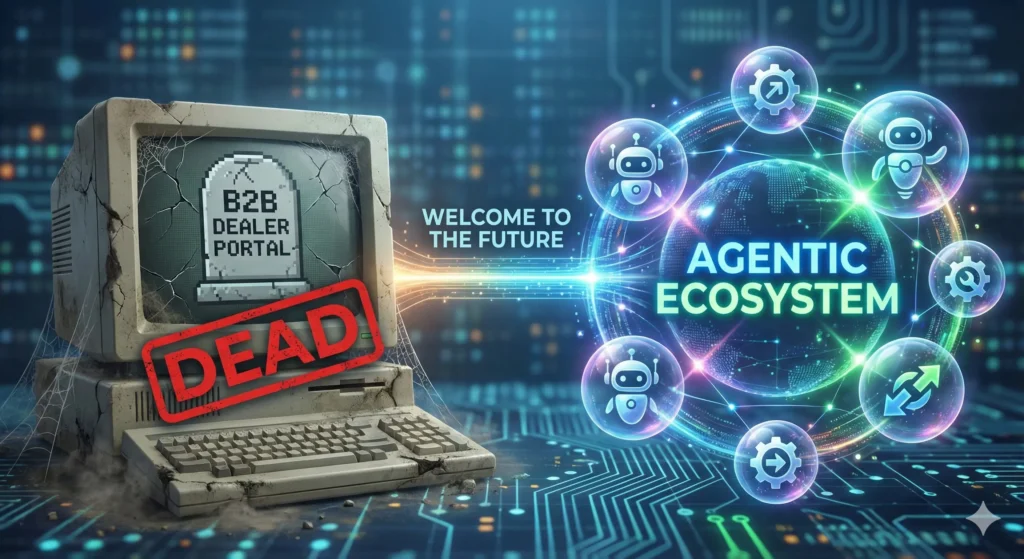
A strategic wake-up call for mid-market manufacturers still treating their dealer networks like data entry clerks
If you’re still calling it a “dealer portal” in 2026, you’re already behind.
For two decades, manufacturers treated dealer portals as digital filing cabinets—a place where distributors could log in, download a PDF catalog, check last month’s orders, and maybe manually key in a purchase. Functional? Sure. Strategic? Not even close.
That era is over.
The Digital Native is Now the VP of Procurement
The generational shift in B2B buying is complete. The person who was a junior associate in 2020 is now running procurement departments. And they have expectations:
The Rule of Thirds:
- One-third of interactions in-person
- One-third via remote human contact
- One-third pure self-service
But here’s the critical part: they expect zero friction moving between these channels. A transaction started on a mobile device at a job site must be seamlessly resolvable by a support agent or territory manager without data loss, without re-keying information, without starting over.
If your “portal” can’t do this, you’re creating friction. And friction drives dealers to competitors who’ve figured this out.
From Predictive to Agentic: AI That Actually Does Something
In 2024 and early 2025, AI in B2B commerce was mostly predictive—recommendation engines suggesting products based on past behavior. Useful, but passive.
By 2026, we’ve entered the age of Agentic AI. The software doesn’t just suggest anymore. It acts.
Modern dealer platforms now have AI agents that:
- Autonomously negotiate inventory allocations when stock runs short
- Resolve warranty claims using visual recognition of failed parts
- Execute complex co-op marketing campaigns on behalf of dealers
- Proactively notify dealers of backorders and suggest substitute SKUs based on technical specifications
This isn’t science fiction. This is table stakes.
What This Actually Means for Your Business
Here’s the hard truth: selecting dealer software is no longer an IT decision about “which shopping cart to use.” It’s a strategic decision about the operating system of your supply chain.
The platforms worth considering in 2026—Salesforce, OroCommerce, BigCommerce, Adobe Commerce, and ZINFI—must be evaluated on their capacity to orchestrate complex, multi-layered relationships, not just their ability to process a credit card.
The Four Non-Negotiables
Any platform you’re considering must deliver on these mandates:
1. Unified Commerce, Not Just eCommerce
The distinction between “online sales” and “offline sales” is obsolete. Your platform must be the single interface for all transactions—whether initiated by a dealer via browser, a sales rep via tablet, or EDI automation.
Data silos between your CRM, ERP, and commerce engine are the primary cause of dealer churn. Full stop.
2. Agentic Workflow Automation
If a dealer has to manually email a sales rep to check on a backorder status, your platform has failed. Period.
Agentic workflows must proactively notify dealers of delays, suggest substitutes based on technical specs, and offer split-shipment options—all without human intervention.
3. Hyper-Personalized Context
“Welcome, User” doesn’t cut it anymore.
The portal must recognize the user’s role and the dealer’s contract status. A shop floor technician should see exploded parts diagrams and service manuals. A procurement officer should see bulk pricing tiers and invoice aging reports.
This granular personalization is now table stakes, not a competitive advantage.
4. ERP as Single Source of Truth
Real-time integration is mandatory. The inventory data displayed to your dealers must reflect the live state of your warehouse.
“Batch updates” that run overnight are unacceptable in a Just-in-Time manufacturing environment where a stockout can halt a production line. The integration architecture—whether API-led or middleware-driven—is your critical success factor.
Real-World Use Cases That Actually Matter
Let’s get practical. Here’s what modern agentic systems actually do:
Autonomous Inventory Reallocation
The old way: Dealer orders 500 units. You have 300. Order goes into backorder limbo. Someone eventually makes a phone call. Deal often dies or gets delayed.
The agentic way: The system detects the shortfall, queries your ERP for production schedules, and engages the dealer directly:
“We have 300 units available for immediate shipment. The remaining 200 are scheduled for production on January 14th. Alternatively, our regional depot has 200 units of the compatible substitute Part B. Would you like to split the shipment or substitute?”
Decision made instantly. No support ticket. No phone call. Revenue preserved.
Proactive Rebate Management
Manufacturing pricing is complex. Volume rebates, tier structures, retrospective adjustments—dealers often don’t realize they’re close to unlocking better pricing.
The agentic approach: When a dealer logs in, they see:
“You are 1,200 units away from unlocking your Tier 2 rebate of 5%. Based on your average run-rate, we recommend increasing your current order by 15% to hit this target by month-end.”
This transforms your portal from a passive order entry screen into an active sales coaching tool that directly drives revenue uplift.
The Platforms That Actually Deliver
I’m not going to waste your time with superficial feature comparisons. Here’s what each platform is actually built for:
Salesforce Manufacturing Cloud & B2B Commerce
Best for: Unified customer-centric architecture across sales, service, and commerce
If you want a single command center for your entire customer relationship—where your territory reps can “masquerade” as dealers, see exactly what they see, and assist with complex orders using the same pricing logic—Salesforce delivers.
Their Agentforce capability isn’t a chatbot. It’s a suite of autonomous agents executing multi-step business processes.
Reality check: 6-12 month implementation. High cost. But if you’re consolidating CRM, service, and marketing stacks onto Salesforce anyway, the TCO starts making sense.
OroCommerce
Best for: Complex, non-standard operational workflows
Built B2B-first from the ground up. If your business processes don’t fit into standard boxes—multi-tier approval workflows, complex RFQ negotiations, dealer-specific pricing matrices—Oro’s workflow engine handles it without custom code.
Open-source architecture gives you complete control. Critical for sensitive industries requiring on-premise or private cloud hosting.
Reality check: 4-8 month implementation. Superior mid-market TCO. Smaller integrator ecosystem than Adobe, but higher average developer seniority.
BigCommerce B2B Edition
Best for: Speed to market and lowest TCO
The agile disruptor. If you need to modernize quickly, reduce technical overhead, and get your dealers online in 3-5 months, BigCommerce wins.
Their “Open SaaS” approach and pre-built connectors for NetSuite and Epicor mean you spend less time on infrastructure and more time on adoption.
Reality check: Functional portal in 3-5 months. Lowest TCO among enterprise contenders. No transaction fees. Hosting included.
Adobe Commerce (Magento)
Best for: Global scale and infinite customization
If you’re a global conglomerate managing hundreds of websites across 50 countries with complex, unique business logic (“pricing based on fluctuating copper spot prices, updated every 15 minutes, multiplied by tier factors distinct to each country”), Adobe can be engineered to handle it.
Their 2026 Edge Delivery Services solved the historic “Magento is slow” problem. Now you get near-perfect performance scores while maintaining massive scale.
Reality check: 6-12+ month implementation. Premium investment. Requires certified developers. This is for organizations with dedicated digital budgets.
ZINFI Unified Partner Management
Best for: Partner enablement and relationship management
This isn’t a commerce platform—it’s a Partner Relationship Management (PRM) system. For manufacturers where dealers don’t just buy, but sell and market your products, ZINFI handles the enablement while your commerce platform handles the transactions.
Through-Channel Marketing Automation lets dealers co-brand your marketing assets and execute campaigns. You track the leads, protect their margins, and gain pipeline visibility.
Reality check: 2-4 month implementation for core modules. Often deployed alongside a commerce engine. Significantly less expensive than full commerce replatforming.
The Implementation Reality Nobody Talks About
Here’s what kills most dealer portal projects: not the software, but the adoption.
Internal Sales Rep Resistance
Sales reps fear the portal will replace them. They’re right to be worried if you position it that way.
The fix: Use platforms that empower reps to use the portal as a tool. Salesforce and BigCommerce both offer “masquerade” capabilities where reps can log in as the dealer, see exactly what they see, and collaborate digitally.
Commission reps on portal orders just as you would phone orders. Position the portal as the administrative assistant handling low-value reorders so reps can focus on selling new product lines.
Dealer Resistance
Dealers are busy running their businesses. They don’t want to learn another system.
The fix: The user experience must be objectively better than picking up the phone. If checking stock on your portal takes 30 seconds and calling support takes 5 minutes, they’ll use the portal. If your portal is slow or requires four passwords, they’ll call every time.
This is why ease of use and performance aren’t “nice to haves”—they’re make-or-break adoption factors.
The Crawl, Walk, Run Approach
Don’t attempt a “big bang” launch. It’s a recipe for failure.
Phase 1: Crawl (MVP – Minimum Viable Portal)
- Goal: Replace PDF catalogs and phone ordering
- Scope: Core catalog, live pricing, stock availability, basic ordering
- Audience: Pilot with 10-20 friendly dealers
- Focus: Validate data accuracy (if your portal says “In Stock” and the warehouse says “Empty,” trust is destroyed instantly)
Phase 2: Walk (Workflow Integration)
- Goal: Reduce administrative friction
- Scope: Invoice portal, RMA automation, quote negotiation, bulk upload tools
- Audience: Top 20% of dealers by volume
- Focus: Train dealers on self-service tools
Phase 3: Run (Agentic Ecosystem)
- Goal: Revenue uplift and autonomous operations
- Scope: AI agents, rebate management, co-op marketing, predictive ordering
- Audience: Full network rollout
- Focus: Drive adoption and share-of-wallet
What’s Coming Next
The trajectory is clear. We’re moving from “headless” to what I’m calling “brainless”—where the UI essentially dissolves.
Dealers may stop logging into websites entirely. Instead, their ERP will talk directly to your ERP via AI agents. Machine-to-machine commerce governed by AI and business rules you define.
In manufacturing specifically, spatial computing (AR/VR) will merge with commerce. A technician wearing smart glasses will look at a broken machine, the AI will diagnose the fault, overlay the replacement part diagram, and they’ll voice-command the order instantly.
Platforms like Adobe and Salesforce are already prototyping these experiences.
The Bottom Line
The choice in 2026 is strategic, not tactical:
- Choose Salesforce if you want a unified, AI-driven command center for your entire customer relationship
- Choose OroCommerce if your business processes are unique, complex, and require an engineering-first platform
- Choose BigCommerce if you want to modernize quickly, reduce technical overhead, and democratize digital access
- Choose Adobe Commerce if you’re a global giant needing infinite scale and deep customization
- Choose ZINFI if your primary goal is activating your dealer network to sell for you
But here’s what I really want you to understand: this isn’t about picking software anymore.
This is about choosing the operating system for your supply chain relationships.
The passive “portal” where dealers logged in to check inventory is dead. What’s replacing it is an active, intelligent ecosystem that anticipates needs, resolves issues autonomously, and turns every dealer interaction into an opportunity to strengthen the relationship and drive revenue.
The question isn’t whether this shift is coming. It’s already here.
The question is whether you’re building the ecosystem, or getting left behind with a “portal.”
Need help evaluating these platforms for your specific manufacturing context? We’re vendor-neutral, solution-obsessed, and we’ve been in the manufacturing warehouse working with AS400 systems—we speak your language. Let’s talk.