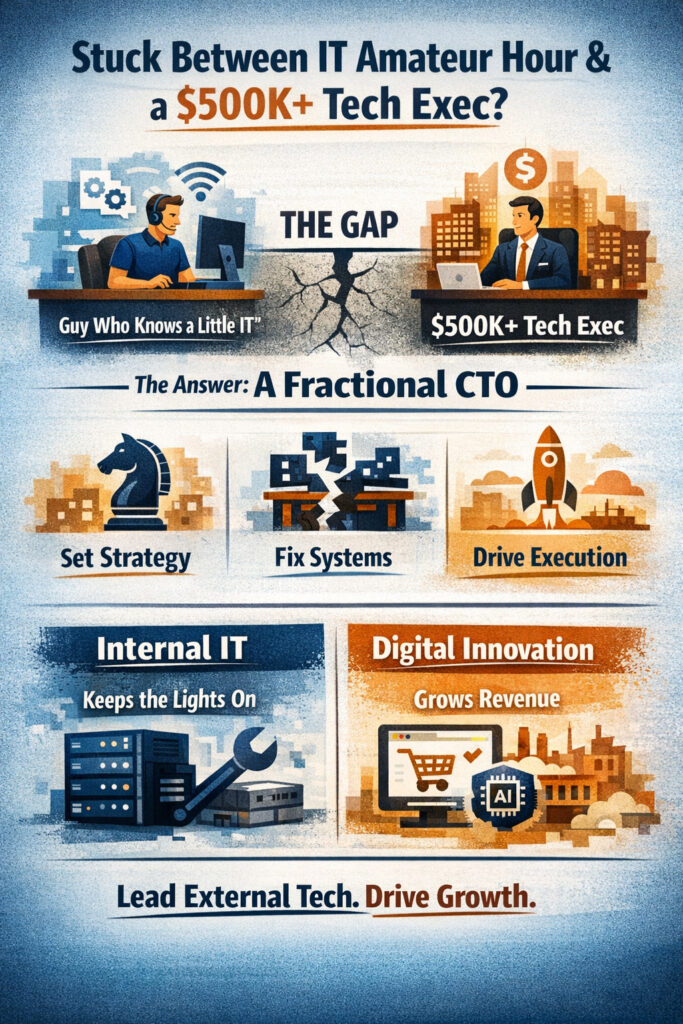
Strategic Technology Leadership in Manufacturing: The Imperative for Chief Technology Officers in B2B Digital Commerce
The industrial manufacturing sector is navigating an unprecedented structural realignment. Historically defined by physical production throughput, localized supply chain logistics, and heavy capital expenditure, the industry is rapidly transitioning into a digital-first ecosystem.1 In this emerging paradigm, a manufacturer’s competitive advantage is dictated as much by its software interfaces, data telematics, and digital customer experiences as it is by factory floor efficiency.2 This profound shift from analog, relationship-based selling to sophisticated, self-serve digital commerce has exposed a critical leadership vacuum within the C-suites of traditional manufacturing enterprises. For decades, the Chief Information Officer (CIO) has been the undisputed sovereign of manufacturing technology, tasked with deploying internal systems, securing corporate data, and optimizing operational costs.4 However, as business-to-business (B2B) buyers increasingly demand sophisticated, consumer-grade online purchasing experiences, a distinct gap has emerged.
This leadership gap cannot be bridged by operational optimization or internal IT management alone. It requires outward-facing, revenue-generating, product-centric technological innovation—the precise operational domain of the Chief Technology Officer (CTO).5 Within the manufacturing context, the term “CIO” remains highly popular and widely understood because technology has historically been viewed solely as internal infrastructure.4 Conversely, the CTO role is frequently misunderstood or entirely absent, despite being the exact executive function required to architect external, customer-facing technologies such as complex B2B e-commerce portals.6
The distinction between these two roles is not merely semantic; it represents a fundamental divergence in strategic mandate, performance metrics, and psychological mindset. As manufacturing companies pivot toward direct-to-customer digital portals, advanced e-commerce platforms, and complex Configure, Price, Quote (CPQ) software architectures, the necessity of dedicated CTO leadership becomes undeniable.3 This exhaustive report provides a granular analysis of the dichotomy between the CIO and the CTO, the unique technical challenges inherent in modern B2B manufacturing commerce, and the strategic imperative of deploying dedicated CTO leadership. Furthermore, it explores how innovative fractional engagement models are democratizing access to elite technical leadership, allowing mid-market manufacturers to architect their digital futures without the crippling overhead of full-time executive compensation.
The Evolution and Anatomy of Technology Leadership
To fully grasp why a modern manufacturing organization requires a CTO to spearhead customer-facing technologies, it is essential to deconstruct the historical evolution and structural mandates of the C-suite technology roles. The emergence, convergence, and subsequent divergence of these positions reflect the growing complexity of the global digital enterprise.
The CIO role originally materialized in the 1980s when large organizations first recognized the absolute necessity of establishing senior leadership to govern internal information systems and business technology.4 Originally dubbed the “computer department” or the “data processing department,” this function was entirely inward-facing, designed specifically to support back-office operations, mainframe computing, batch processing, and internal communications.8 Over time, as enterprise resource planning (ERP) systems, customer relationship management (CRM) tools, and human resources information systems (HRIS) became ubiquitous across the industrial sector, the CIO’s mandate expanded significantly to encompass enterprise-wide digital architecture, massive vendor management portfolios, and comprehensive cybersecurity.4 Because organizations were continually pouring capital into technologies following an organizing model designed for a bygone era, the IT department often developed a reputation as a bottleneck—stereotypically characterized as the “department of no,” fraught with legacy baggage and rigid operational constraints.8
The CTO role, by contrast, evolved significantly later and under entirely different market conditions. Initially emerging within pure-play technology, software-as-a-service (SaaS), and internet companies, the CTO was effectively the chief engineer—the visionary responsible for research and development (R&D) and the creation of the actual software or hardware products that the company sold directly to the market.4 During the rapid technological expansion of the 1990s and 2000s, as the internet boom temporarily blurred the lines between internal IT infrastructure and external digital products, the CIO and CTO roles occasionally became intertwined or conflated within traditional enterprises.1
However, the maturity of the modern digital economy has definitively separated them once again. Today, the demands of enterprise technology require both operational excellence and aggressive innovation leadership, prompting a distinct separation of duties.4 Companies that clearly define and separate their CTO and CIO roles report a 35 percent improvement in technology execution and substantially better alignment between long-term innovation and daily operations.4 In modern established industries like manufacturing and financial services, the CIO remains the established role managing core business systems, while the CTO is increasingly introduced as a newer, peer-level role focused specifically on digital transformation, digital product engineering, and external market responsiveness.4
Deconstructing the CIO versus CTO Paradigm in Manufacturing
The friction that often occurs between CIOs and CTOs is rarely born of interpersonal malice; rather, it stems from structurally opposed mandates and divergent performance incentives.9 A comprehensive Gartner survey highlighted that 42 percent of companies experience coordination issues and operational friction between these two tech leaders, stemming directly from their overlapping yet fundamentally distinct goals.10 Understanding this dichotomy requires a deep analysis of their respective domains, financial mandates, and psychological postures.
The Chief Information Officer: Masters of the Bottom Line
The CIO is fundamentally the master of the organization’s bottom line. The primary mandate of the CIO is strictly inward-facing, focusing on the employees, the internal operations, and the relentless optimization of the company’s cost structure.6 A successful CIO views technology through the lens of operational efficiency, risk mitigation, and standardization. The simplest heuristic to understand this role is that the CIO runs the intranet, ensuring that all internal departments operate efficiently and that business goals are completed within an acceptable operational framework.5
In a manufacturing setting, the CIO is responsible for the digital nervous system of the factory floor and the corporate office. This broad purview includes managing the ERP systems that track physical inventory, maintaining the internal networks that facilitate employee communication, and establishing the cybersecurity protocols that protect proprietary engineering blueprints and sensitive financial data.4 The central question driving a CIO’s strategy is consistently, “How can technology make our current internal processes faster, cheaper, and more secure?”.6
Consequently, the metrics of success for a CIO are deeply rooted in operational stability and cost control. Key performance indicators (KPIs) include system uptime, network security efficacy, adherence to rigid compliance frameworks (such as GDPR, SOC 2, or ISO standards for internal data governance), and the continuous reduction of technical overhead.4 Because their function is traditionally viewed by the executive board as a necessary cost center, CIOs are naturally incentivized to decrease spending, minimize operational risks, and consolidate vendor contracts.6 They are the guardians of the status quo, ensuring that the foundational digital systems upon which the company relies operate flawlessly twenty-four hours a day without unexpected disruptions.11
The Chief Technology Officer: Architects of the Top Line
In stark contrast, the CTO is the architect of the organization’s top line. The CTO’s mandate is decidedly outward-facing, focusing squarely on the external customer, the broader market, and the generation of new revenue streams through technological innovation.6 Rather than asking how to optimize existing internal processes, the CTO asks, “How can we leverage emerging technologies to build better products, enter new markets, and create a sustainable competitive advantage?”.6 If the CIO runs the intranet, the CTO runs the internet.6
The CTO operates simultaneously as a product visionary and an engineering leader. In the context of a manufacturing company, the CTO is rarely concerned with whether the human resources department’s payroll software is functioning efficiently; instead, the CTO is obsessively focused on developing an external, customer-facing e-commerce portal, integrating Internet of Things (IoT) sensors into physical products to offer predictive maintenance as a service, and building custom application programming interfaces (APIs) to allow clients to interface directly with the company’s digital ecosystem.3 The CTO takes ownership of the entire technology strategy for the product, making foundational architecture decisions regarding the use of monolithic structures versus microservices, selecting optimal cloud providers, and building a high-performance engineering culture.6
The CTO’s success metrics are intrinsically linked to business growth rather than cost reduction. They are measured by product shipment velocity, technological innovation, market share expansion, and the top-line revenue directly generated by digital products and customer-facing interfaces.6 Unlike the CIO, the CTO is viewed as managing a profit center.14 They operate without the rigid constraints of traditional IT cost-cutting, instead advocating for strategic investments in advanced technologies like artificial intelligence (AI), machine learning, and cloud-native application development to keep the company ahead of the curve and aligned with consumer expectations.5
Strategic Friction and Necessary Synchronization
When a manufacturing firm decides to launch a digital customer portal or an advanced B2B e-commerce platform, the interaction between these two roles becomes critical. The CTO will focus on the aesthetic user experience, engineer the front-end application, develop the microservices architecture, and ensure the product excites the customer.6 Simultaneously, the CIO must be involved to ensure that the underlying legacy ERP system can actually handle the volume of API calls generated by the new portal, and that internal data governance and security policies are strictly enforced.4
Large tooling and integration decisions typically span both domains. The CIO will often lead the vendor strategy, data governance, and security reviews to minimize risk, while the CTO will focus on how the tools fit into the broader development ecosystem and support end-to-end product workflows.9 When these distinct roles are conflated into a single position—or when a traditional CIO is tasked with building external products—organizations inevitably default to prioritizing internal operational stability over external innovation, effectively stalling their digital growth in a highly competitive market.4 A truly distinguished technology strategy requires the delicate balance of the CIO’s discipline in margin management and security with the CTO’s aggressive pursuit of breakthrough revenue opportunities.18
| Strategic Dimension | Chief Information Officer (CIO) | Chief Technology Officer (CTO) |
| Primary Focus | Inward-facing; optimizing internal employees and operations 6 | Outward-facing; optimizing external customers and digital products 6 |
| Financial Mandate | Bottom-line optimization; universally viewed as a cost center 6 | Top-line revenue generation; positioned as a profit center 6 |
| Core Responsibilities | IT infrastructure, ERP/CRM management, Intranet, enterprise systems, support 4 | Digital product engineering, Customer portals, APIs, Internet, technical architecture 6 |
| Security Paradigm | Infrastructure security, corporate compliance, internal network defense 4 | Application security, product compliance, external customer data protection 4 |
| Data Utilization Focus | Business Intelligence (BI), operational analytics, financial reporting, governance 4 | Product analytics, user behavior tracking, customer telemetry, market trends 6 |
| Primary Success Metrics | System uptime, budget adherence, cost reduction, efficiency, risk mitigation 6 | Time-to-market, product adoption rates, revenue growth, technological innovation 6 |
| Typical Reporting Structure | Often reports directly to the Chief Executive Officer (CEO) or Chief Financial Officer (CFO) 6 | Often reports directly to the CEO or Chief Product Officer (CPO) 6 |
| Psychological Posture | Optimizer, risk-averse, standardizer, protector of the core infrastructure 5 | Innovator, risk-tolerant, disruptor, challenger of the industry status quo 1 |
The Macro-Economic Shift: B2B E-commerce and Industrial Portals
The traditional archetype of the manufacturing industry—producing physical goods and selling them exclusively through localized sales representatives, thick paper catalogs, or wholesale distributors—is becoming rapidly obsolete. Driven by sweeping demographic changes in B2B procurement, the lasting aftermath of global supply chain disruptions induced by the COVID-19 pandemic, and the relentless march of digital technology, the manufacturing sector is undergoing a massive and irreversible structural realignment.20
The Explosion of B2B Digital Commerce
The modern B2B buyer is no longer satisfied with the archaic process of calling a sales representative and waiting days for a manual price quote. A profound demographic shift has occurred: millennial and Generation Z professionals now constitute the vast majority of B2B procurement roles, and they implicitly expect the same frictionless, intuitive, and immediate digital purchasing experiences they encounter as consumers on platforms like Amazon or consumer retail sites.16 This behavioral shift has rendered an enhanced digital customer experience not just a competitive advantage, but absolute “table stakes” for survival in industrial manufacturing.21 Approximately 94 percent of B2B buyers now state a preference to shop online, heavily favoring remote human assistance or digital self-service over traditional in-person sales engagements.20
The economic implications of this transition are staggering in their magnitude. U.S. manufacturing and wholesale distribution sales reached an astonishing $15.12 trillion in 2025.23 While the total sales growth was a modest 0.4 percent following the post-pandemic stabilization, the underlying mechanism of how those purchases are made is shifting radically.23 Within the broader industrial market, digital B2B e-commerce sales are the primary, undeniable engine of growth. In 2024, total B2B e-commerce sales reached $2.43 trillion, representing a massive 17 percent jump from the previous year, far outpacing the anemic 1.5 percent growth of the overall B2B market encompassing all traditional channels.24
Perhaps most tellingly, buyer willingness to execute massive, multi-million-dollar transactions entirely through digital self-service portals has skyrocketed, demonstrating unprecedented trust in digital infrastructure. Data from a 2024 B2B Pulse survey revealed that 39 percent of buyers were willing to spend more than $500,000 in a single online transaction, up significantly from just two years prior.24 Furthermore, 20 percent were willing to spend over $1 million online, and 11 percent were comfortable executing individual transactions exceeding $5 million without traditional, face-to-face sales intervention.24
Recognizing this existential shift, the manufacturing industry is responding with aggressive capital deployment. Research indicates that 85 percent of B2B organizations now possess some form of an e-commerce storefront or self-service portal, and 66 percent of manufacturing firms have explicitly stated plans to significantly increase their investments in enhancing customer portals to capture this digital revenue.25 They understand that a failure to offer sophisticated digital commerce capabilities will result in immediate, catastrophic market share erosion. The financial data supports this urgency: industrial companies that establish themselves as digital leaders generate total returns to shareholders of 47 percent, compared to a mere 27 percent for digital stragglers.20
The Rise of Servitization and “As-A-Service” Models
Parallel to the rise of digital storefronts is a profound macro-trend known as “servitization”.16 Forward-thinking manufacturers are recognizing that the physical product is no longer the sole, or even the primary, locus of value creation. Instead, the physical product serves as a baseline platform for the delivery of ongoing, high-margin digital services. This transition moves companies away from a pure transactional model—selling a piece of industrial machinery once and walking away—to a relational model, where the machinery is sold alongside recurring predictive maintenance subscriptions, digital performance analytics dashboards, and automated consumable replenishment contracts.3
To enable this, modern industrial equipment is increasingly embedded with IoT sensors that stream real-time telemetry data back to the manufacturer.3 A CTO is strictly required to architect the complex, high-throughput data pipelines necessary to ingest, process, and analyze this massive influx of unstructured data. Through the application of Predictive AI and machine learning algorithms, the CTO enables the manufacturer to alert a customer that a machine component is highly likely to fail within seventy-two hours, automatically generating a digital quote for a replacement part, and seamlessly scheduling a service technician through the customer portal.2 This level of proactive, technology-driven customer service fundamentally alters the manufacturer’s revenue profile, creating predictable recurring revenue streams and deepening client entrenchment to the point of indispensability. A traditional CIO, focused strictly on internal network stability and legacy ERP maintenance, rarely possesses the product-engineering mindset or the agile architectural skills required to build and monetize these complex, external-facing data products.6
The Technical Crucible: Why Customer-Facing Tech Requires a CTO
Given the immense magnitude of the B2B e-commerce opportunity, executive boards might erroneously assume that the deployment of an online storefront is a straightforward IT initiative that naturally falls under the purview of the incumbent CIO. This fundamental misunderstanding of the technical landscape is precisely why so many manufacturing digital transformations fail spectacularly. Building a robust B2B digital commerce ecosystem is vastly more complex than launching a standard retail B2C website, and it requires the specialized architectural, systems engineering, and product-management expertise of a dedicated CTO.27
Configure, Price, Quote (CPQ) Intricacies
In industrial manufacturing, products are rarely sold off-the-shelf in standard configurations. They are highly customized, modular, and engineered to highly specific client requirements, physics constraints, and operational environments. Consequently, the transition from a slow, manual Engineer-to-Order (ETO) model to a rapid, automated Configure-to-Order (CTO) model is the absolute cornerstone of modern B2B commerce.7 This requires the seamless implementation of advanced Configure, Price, Quote (CPQ) software architectures.
A CTO must design and integrate a constraint-based configuration engine that guarantees every product configuration built by a customer on the portal is both technically viable (adhering to strict engineering rules, material durability, and physics) and commercially optimized (accounting for real-time supply chain constraints, inventory availability, and margin requirements).7 Without robust configurator tools engineered by a CTO, the buying process becomes cumbersome and error-prone, requiring excessive back-and-forth between external sales, internal engineering, and pricing teams.7 Furthermore, top-tier CTOs are elevating this experience by integrating real-time 3D visualization and Augmented Reality (AR) directly into the browser application, dynamically updating a high-resolution 3D model as the buyer selects options, thereby eliminating uncertainty before the execution of a multi-million dollar transaction.7
Deep ERP Integration and Dynamic Pricing
B2B pricing logic is notoriously complex, governed by multi-tiered customer contracts, bulk volume discount matrices, regional tax tariffs, and real-time fluctuations in raw material costs.22 A CTO is responsible for building a dynamic pricing architecture that instantly calculates and renders the correct, personalized price for a specific authenticated user, completely eliminating the manual quoting process that historically delayed sales cycles by weeks.7
Perhaps the most formidable technical challenge facing the CTO is integrating the external e-commerce platform with the manufacturer’s legacy internal systems, particularly the ERP and Product Information Management (PIM) software.17 Approximately 80 percent of B2B organizations prioritize integrating their e-commerce technology deeply with their cloud-based or on-premise ERP systems to eliminate siloed operations and system fragmentation.17 If a B2B portal displays inaccurate inventory levels, outdated pricing, or incorrect technical specifications, customer trust is instantly destroyed, and the sale is lost.32 The CTO must design a robust, API-driven communication architecture that facilitates the real-time, bi-directional synchronization of master data, ensuring that the customer portal reflects the exact reality of the factory floor, the warehouse, and the accounting ledger.17
Composable Architecture vs. Monolithic Legacy Systems
When a CIO—whose core expertise lies in managing massive, monolithic systems like SAP, Oracle, or legacy Microsoft Dynamics—attempts to build an e-commerce platform, the default operational approach is often to simply purchase an e-commerce “bolt-on” module provided by the legacy ERP vendor. This approach frequently results in an inflexible, slow, and clunky user interface that fails to meet modern B2B user experience (UX) and user interface (UI) standards, ultimately losing buyers who expect frictionless navigation.16 Legacy approaches simply cannot keep up with the speed of market shifts or rising consumer expectations.33
A CTO brings a radically different, modern architectural philosophy: “Composable Commerce”.16 Instead of relying on a monolithic, one-size-fits-all software suite that is deeply coupled and difficult to upgrade, the CTO componentizes the IT landscape.16 They select the absolute best-in-class, independent software solutions for each specific function—deploying one specialized engine for AI-driven search, another for CPQ logic, another for inventory management, and a dedicated framework for the front-end presentation layer.16
These microservices are entirely decoupled but communicate seamlessly via APIs in a cloud-native environment.16 This MACH architecture (Microservices, API-first, Cloud-native, and Headless) provides unparalleled organizational agility.34 If the manufacturer wants to update the user interface of their portal or launch a new mobile application, the CTO can deploy the changes to the “head” (the front-end) without risking any disruption or requiring downtime for the underlying ERP or core commerce engine.16 This fundamentally prevents the “architectural paralysis” that plagues so many traditional manufacturing firms, enabling them to release new features rapidly, adapt to fluid market demands, and scale their infrastructure elasticity to handle peak traffic surges without catastrophic site crashes.3 By embracing first principles thinking, creative destruction, and greedy algorithms, the CTO builds an antifragile e-commerce ecosystem designed to thrive under stress.33
Cybersecurity in the Outward-Facing Paradigm
The rise of massive B2B e-commerce platforms brings with it an exponentially increased risk of cyber threats and data breaches.32 While a CIO is traditionally focused on securing the internal perimeter, protecting employee laptops, and maintaining corporate compliance, the CTO must fortify the digital fortresses of public-facing platforms.35 The CTO is tasked with safeguarding sensitive customer information, high-value financial transactions, and proprietary business data exposed to the public internet.35 This outward-facing security posture requires constant vigilance, the deployment of advanced application-level security measures, the management of consumer privacy regulations across global jurisdictions, and the architecture of systems that are secure by design without impeding the customer’s purchasing friction.6
The Fractional CTO: A Strategic Imperative for Mid-Market Manufacturers
While multinational manufacturing conglomerates like Airbus or Walmart possess the vast capital required to recruit top-tier, full-time CTOs from Silicon Valley, small and medium-sized enterprises (SMEs) in the manufacturing sector face a harsh economic reality.2 The median salary for a high-level technology executive routinely exceeds $300,000, and when factoring in equity compensation, executive bonuses, and comprehensive benefits, the annual cost of a full-time CTO can easily surpass $480,000.6 For a mid-market manufacturer operating on tight production margins, this overhead is often financially unjustifiable, leaving them vulnerable to digital disruption.15
Yet, the technological imperative remains absolute. A mid-market manufacturer competing on a global stage needs the exact same architectural vision, microservices expertise, cybersecurity posture, and digital strategy as an enterprise giant.15 To resolve this paradox, the industrial sector has witnessed a massive, sustained surge in the adoption of the “Fractional CTO” model.40
Defining the Fractional Leadership Model
A Fractional CTO is a highly experienced, executive-level technology leader who serves an organization on a part-time, retainer, or project basis, bringing the strategic insight of a full-time executive without the full-time financial burden.15 Unlike a tactical IT consultant who delivers a static report and departs, or an interim CTO who temporarily fills a full-time vacancy for a fixed term to manage a crisis, a Fractional CTO integrates deeply into the executive team.38 They take definitive ownership of the technology roadmap, lead the internal and external engineering staff, and make critical architectural decisions over a sustained, multi-year relationship.40
By distributing their deep expertise across a select portfolio of non-competing companies, Fractional CTOs provide world-class leadership at a fraction of the cost.15 They bring a wealth of cross-industry knowledge, applying cutting-edge consumer tech innovations, AI best practices, and agile methodologies directly to the B2B manufacturing space, thereby circumventing the insular thinking that often plagues legacy industries.39
Cost-Benefit Analysis and Engagement Dynamics
The financial arbitrage of the Fractional CTO model is highly compelling for mid-market boards. Engagement costs typically range from $3,000 to $15,000 per month on a retainer basis, representing a 40 to 70 percent cost reduction compared to a permanent executive hire.3 However, the true value extends far beyond mere payroll savings; it fundamentally alters the risk profile of technology investments.39
| Engagement Model | Financial Cost Structure | Strategic Focus & Duration | Primary Benefits & Limitations |
| Full-Time CTO | $303,874 base + ~$183,000 in benefits and bonuses 37 | Long-term, 100% dedicated focus on a single organization 40 | Deep cultural integration and daily oversight. High financial risk, difficult to terminate, requires 3-6 months to onboard.37 |
| Interim CTO | £800-£1,500/day ($1,000-$1,900/day); Full-time hours 42 | Fixed-term (3-12 months); specific project or transition focus 42 | Rapid deployment for crisis management or urgent digital transformation. Knowledge transfer risk at the end of the contract.42 |
| Fractional CTO | $3,000-$15,000/month retainer; Part-time hours 37 | Ongoing partnership (6 months – 3+ years); Long-term strategy 42 | Highly cost-effective (60% savings), scalable engagement, continuous strategic guidance, broad cross-industry perspective.37 |
The Strategic Execution Lifecycle
When a Fractional CTO engages with a manufacturing firm to build a digital customer experience or modernize infrastructure, they follow a rigorous, proven four-step methodology to bridge the vast gap between abstract business goals and concrete technical execution.3
- Discovery and Assessment: The engagement invariably begins with a comprehensive technical audit.3 The Fractional CTO assesses the existing IT infrastructure, evaluates the legacy ERP and CRM systems, and critically analyzes the capabilities of the internal development team. They identify critical operational bottlenecks, hidden technical debt, and security vulnerabilities that could severely compromise an external deployment.3 Crucially, they act as an essential translator, breaking down the complex language barrier that often exists between business executives demanding rapid revenue growth and the internal IT department that fears system instability and change.43
- Strategic Roadmap and Architecture: Following the discovery phase, the CTO develops a prioritized, actionable technical strategy.3 They step in to decisively resolve the “Architectural Decision Paralysis” that frequently stalls manufacturing innovation.3 They make definitive rulings on monolith versus microservices architectures, select the optimal cloud platform (AWS, GCP, Azure), determine the appropriate database technologies (PostgreSQL, MongoDB), and map the intricate API integration pathways required to safely synchronize the e-commerce front-end with the factory floor backend.3
- Implementation and Execution: The Fractional CTO does not merely advise from the sidelines; they execute. They provide hands-on, authoritative leadership to the engineering team, whether that team consists of internal legacy developers or an outsourced software development agency.3 They establish high-performance engineering cultures, implement strict Agile methodologies, oversee the creation of robust DevOps deployment pipelines, and conduct rigorous code reviews to ensure quality.3 For manufacturing firms that inherently struggle to attract and retain elite senior software developers, the Fractional CTO provides necessary mentorship, capacity building, and conducts technical interviews to intelligently build out the team’s internal capabilities.3
- Continuous Optimization and Scaling: Once the B2B portal or digital service is successfully launched, the Fractional CTO’s role shifts to implement sophisticated analytics and telemetry systems to continuously monitor performance.3 They track technical metrics (system uptime, page load speeds, API latency) alongside commercial metrics (conversion rates, digital revenue, customer adoption).3 They aggressively manage ongoing technical debt, ensure continuous compliance with stringent data privacy regulations like GDPR and SOC 2, and seamlessly scale the cloud infrastructure as user traffic grows, preventing the AWS bills from skyrocketing unnecessarily.3
Quantifying Success: ROI and Key Performance Indicators
To firmly justify the investment in a Fractional CTO and the subsequent capital expenditure required for digital platform development, manufacturing executives must track specific, objective metrics that prove the financial viability of the technology.45 The industrial sector requires a longer-term perspective on Return on Investment (ROI) compared to the fast-moving consumer goods sector, primarily because the sales cycles for heavy equipment or bulk materials often stretch over six to twelve months.46
A successful CTO-led digital transformation will directly and measurably impact several core business metrics. Foremost, it will drastically reduce Customer Acquisition Cost (CAC).46 By deploying an SEO-optimized, highly functional digital portal, manufacturers can attract, educate, and convert organic traffic without relying entirely on expensive, geographically constrained field sales teams or wholesale distributors who continuously erode profit margins.22
Secondly, the platform will systematically increase the Customer Lifetime Value (LTV).46 A well-architected B2B portal provides customers with frictionless self-service access to comprehensive asset management tools, product documentation, exploded CAD views, and automated spare parts ordering capabilities.16 This seamless experience cultivates deep loyalty; when procurement officers can effortlessly reorder complex, proprietary parts at 2:00 AM without speaking to a sales representative, they rarely defect to a competitor with an inferior digital presence. A high customer retention rate is a direct, undeniable indicator of digital success, and increasing retention yields compounding revenue generation from existing accounts, which McKinsey notes accounts for 80 percent of value creation in successful companies.47
Finally, the automation of the complex B2B sales process generates profound operational savings. By implementing an intelligent CPQ system and an integrated digital portal, the CTO effectively eliminates the manual labor previously required for data entry, technical quote generation, and basic order processing.17 This operational efficiency allows the existing sales force to pivot from being simple administrative order-takers to strategic account managers focusing on high-value, complex consultative selling.16 The Marketing ROI (MROI) in manufacturing should strive for baseline ratios of 5:1, scaling rapidly upwards of 10:1 or 15:1 as the digital infrastructure matures and economies of scale are fully realized.46
Beyond standard marketing metrics, the utilization of a Fractional CTO yields specific, quantifiable organizational improvements. Data analysis indicates that companies utilizing fractional tech leadership report, on average, an 18 percent higher revenue growth and a 15 percent increase in overall profitability.37 Operationally, these CTOs track productivity through development velocity and deployment frequency, typically delivering 20 to 45 percent improvements in these areas within the first six months of engagement.48 By anticipating industry trends, avoiding costly architectural dead-ends, and significantly accelerating the time-to-market for digital portals, the Fractional CTO delivers financial returns that vastly outpace their retainer fees.39
Empirical Validation: Case Studies in Manufacturing Digital Transformation
The theoretical frameworks of CTO leadership, composable architecture, and fractional engagement models are robustly validated by empirical successes across the manufacturing landscape. Organizations that strategically empower technology leadership to architect customer-facing platforms consistently achieve dominant market positions.
SRMB RealBuild: Engineering a Complete B2B Ecosystem
SRMB RealBuild, a highly ambitious startup within the traditional construction materials manufacturing sector, sought to fundamentally disrupt the archaic, relationship-dependent procurement model by launching a comprehensive B2B e-commerce platform.50 Recognizing the extreme technical complexity of the endeavor—which required integrating dynamic pricing, logistics coordination, and complex credit management—they utilized a Fractional CTO model through embedded Forward-Deployed Engineers (FDEs).50
The acting Fractional CTO served effectively as the technical co-founder, making critical decisions to build a highly scalable architecture utilizing a modern React/Next.js frontend and a Node.js backend.50 The resulting platform managed the entirety of the complex B2B workflow: custom pricing tiers, bulk ordering algorithms, quote management, and multi-stage approval workflows.50 Crucially, the CTO architected an intelligent inventory management system that provided real-time tracking across multiple physical warehouses, utilized historical data for demand forecasting, and featured a comprehensive self-service supplier portal.50 By seamlessly merging deep industrial knowledge with modern, cloud-native e-commerce practices, the CTO successfully digitized an incredibly resistant, legacy sector of the economy.
Valtech’s GEAR and the Power of Composable Manufacturing
The strategic necessity of the composable architecture approach is vividly illustrated by Valtech’s “GEAR” accelerator, explicitly designed for B2B customer portals in manufacturing.16 Recognizing that traditional monolithic software setups were failing industrial manufacturers—causing scattered IT landscapes, poor data quality, and rigid customer experiences—Valtech engineered a 100 percent composable foundation based on the commercetools platform.16
By componentizing features rather than relying on a rigid, one-size-fits-all ERP extension, GEAR allows manufacturers to rapidly deploy specific, high-value applications tailored to exact customer journeys.16 For example, the system exposes critical equipment data—such as Bills of Materials (BOMs), operating manuals, and comprehensive maintenance histories—directly to the end user in an intuitive interface.16 It utilizes headless digital commerce APIs to expedite the sales of highly lucrative aftermarket spare parts, offering customer-specific pricing catalogs and adjustable checkout flows.16 The deployment of such advanced, API-first architecture is precisely the domain of a visionary CTO, who understands that decoupling the front-end user experience from the legacy backend is the only sustainable way to achieve true digital agility and speed.16 Organizations utilizing such composable approaches report that sales engineers quickly become strong advocates for self-serve options once they realize the portal automates lower-tier sales, allowing them to earn higher commissions on complex deals with less manual effort.16
Advanced CPQ Integration: Tacton and In Mind Cloud
The necessity of CTO leadership to solve complex B2B logic is demonstrated by the deployment of advanced CPQ systems. Tacton CPQ, for instance, specifically addresses the challenges of complex B2B sales by moving manufacturers from slow Engineer-to-Order models to rapid Configure-to-Order models.7 By implementing constraint-based configurators, the system ensures that highly customizable machinery quotes are technically valid and commercially optimized in real time, eliminating the inefficiencies of traditional sales processes.7 Similarly, In Mind Cloud highlights the broader industry trends of specialization and cloud migration, noting that medium-sized enterprises require continuous end-to-end CPQ processes that deeply integrate with CRM and e-commerce platforms.29 Orchestrating the integration of these sophisticated, cloud-native CPQ engines with legacy ERP systems is a high-stakes technical endeavor that strictly requires the architectural oversight of a CTO, ensuring data fidelity across all enterprise systems.7
Global Industrial Leaders: Airbus, MacDon, and Walmart
Beyond mid-market firms and startups, massive global entities have aggressively pursued digital transformation under visionary technology leadership. Manufacturers like Airbus, MacDon, and Mueller have implemented comprehensive digital transformations to streamline their internal operations, reduce production costs, and dramatically enhance the digital customer experience, leading to direct increases in sales.2 Similarly, retail giant Walmart rapidly accelerated its digital and e-commerce capabilities by acquiring Jet.com and leveraging its technical expertise, while simultaneously partnering with Microsoft to utilize advanced cloud architecture, IoT, machine learning, and AI solutions.36 The success of these massive initiatives hinged on strong executive leadership driving the organization toward digitalization and fostering a culture of adaptability and innovation—the exact cultural shift championed by an effective CTO.36 These empirical successes demonstrate that whether an organization is a specialized regional distributor or an aerospace titan, the strategic integration of outward-facing technology is a non-negotiable imperative for long-term survival.
Conclusion
The industrial manufacturing sector has crossed a definitive digital Rubicon. The era in which a manufacturer could rely solely on the physical superiority of its fabricated product and the interpersonal strength of its localized sales network has officially ended. Today, the comprehensive digital experience surrounding the product—how it is customized online, priced in real-time, seamlessly purchased, proactively monitored via IoT, and effortlessly maintained through digital portals—is equally critical to commercial success and market dominance.
This profound industry transformation demands a corresponding structural evolution in executive leadership. While the Chief Information Officer remains absolutely indispensable for securing enterprise data, managing massive internal resources, maintaining core infrastructure, and relentlessly optimizing the bottom line, the CIO’s inherently inward-facing, risk-averse mandate is fundamentally ill-suited for the rapid, iterative development of cutting-edge digital products. To capture their share of the multi-trillion-dollar B2B digital commerce opportunity, manufacturers must strategically deploy a Chief Technology Officer. The CTO serves as the unapologetic architect of the top line, bringing the product engineering mindset necessary to untangle complex CPQ logic, implement composable headless architectures, and seamlessly integrate legacy ERP systems with modern, frictionless customer portals.
For small and medium-sized enterprises where a full-time, half-million-dollar technology executive is financially unfeasible, the Fractional CTO model provides an elegant, highly scalable, and high-ROI solution. By delivering elite strategic vision, unblocking persistent architectural paralysis, and driving rigorous digital execution on a flexible basis, the Fractional CTO enables mid-market manufacturers to punch far above their weight class and compete aggressively on a global scale. Ultimately, organizations that possess the foresight to recognize the stark dichotomy between internal IT optimization and external digital innovation—and subsequently empower dedicated CTO leadership to drive the latter—will systematically dominate the next century of industrial manufacturing. Those who fail to adapt their leadership structures will inevitably find themselves relegated to the analog past, outpaced by competitors who understood that in the modern economy, software is the ultimate operational leverage.
Works cited
- What are the responsibilities of a CIO versus a CTO? – McKinsey, accessed February 19, 2026, https://www.mckinsey.com/featured-insights/mckinsey-explainers/what-are-the-responsibilities-of-a-cio-versus-a-cto
- 3 Examples of Successful Digital Transformation in Manufacturing – Liferay DXP, accessed February 19, 2026, https://www.liferay.com/blog/customer-experience/-3-examples-successful-digital-transformation-manufacturing
- Fractional CTO for Manufacturing | IoT & Predictive AI, accessed February 19, 2026, https://fractionalctoexperts.com/industries/manufacturing
- CTO vs. CIO: The Evolving Roles in the Modern Enterprise – BETSOL, accessed February 19, 2026, https://www.betsol.com/blog/cto-vs-cio-in-the-modern-enterprise/
- CIO vs CTO: How Do These Roles Differ? – Burtch Works, accessed February 19, 2026, https://www.burtchworks.com/industry-insights/cio-vs-cto-how-do-these-roles-differ
- CIO vs CTO: Key Differences Explained | Which Role Is Right?, accessed February 19, 2026, https://www.amazingcto.com/cio-vs-cto/
- Optimizing Complex B2B Sales with Tacton CPQ – QKS Group, accessed February 19, 2026, https://qksgroup.com/blogs/optimizing-complex-b2b-sales-with-tacton-cpq-956
- How Shifting the Focus from Cost Center to Value Engine Means Erasing the IT Box from the Organization Chart – AIS eLibrary, accessed February 19, 2026, https://aisel.aisnet.org/cgi/viewcontent.cgi?article=1633&context=misqe
- CIO vs CTO: what product leaders need to know to align strategy and technology – Airfocus, accessed February 19, 2026, https://airfocus.com/glossary/cio-vs-cto/
- CTO vs CIO: Navigating the Strategic Differentiation in Tech Leadership, accessed February 19, 2026, https://www.c-suite-strategy.com/blog/cto-vs-cio-navigating-the-strategic-differentiation-in-tech-leadership
- Who’s who in the zoo? Clarifying the difference between the chief digital officer and chief information officer – Sabinet African Journals, accessed February 19, 2026, https://journals.co.za/doi/10.4102/sajim.v26i1.1670
- CIO vs CTO: What’s the Difference and Which Do You Need? – Interim Executives, accessed February 19, 2026, https://interimexecs.com/cio-vs-cto/
- CIO vs CTO: Who’s Really Driving Innovation in the Digital Age? | ITeXchange Blog, accessed February 19, 2026, https://www.it.exchange/blog/cio-vs-cto-whos-really-driving-innovation-in-the-digital-age/
- CIO vs. CTO: Chief collaborators in tech, accessed February 19, 2026, https://www.cio.com/article/189278/cio-vs-cto-chief-collaborators-in-tech.html
- Why Every Business Needs a CTO – MarksNelson, accessed February 19, 2026, https://www.mnadvisors.com/blog/post/why-every-business-needs-a-cto-2
- B2B manufacturing: reshaping the industrial landscape | Valtech, accessed February 19, 2026, https://www.valtech.com/blog/customer-portals-b2b-manufacturing/
- How to Integrate B2B eCommerce with Your ERP System – Commercetools, accessed February 19, 2026, https://commercetools.com/blog/making-your-b2b-ecommerce-smarter-with-a-seamless-erp-integration
- Profit-First CIO: Transforming IT from Cost Center to Revenue Engine – Vantedge Search, accessed February 19, 2026, https://www.vantedgesearch.com/resources/blogs-articles/profit-first-cios-tech-leaders-as-revenue-champions/
- CIO vs. CTO: What’s the Difference? – BMC Software | Blogs, accessed February 19, 2026, https://www.bmc.com/blogs/cio-vs-cto-whats-the-difference/
- Learn How U.S. Manufacturers Can Embrace Digital Commerce – ASME, accessed February 19, 2026, https://www.asme.org/topics-resources/content/manufacturing-blog-how-manufacturers-can-implement-digital-transformation
- The future of the digital customer experience in industrial manufacturing and construction, accessed February 19, 2026, https://www.deloitte.com/us/en/insights/industry/manufacturing-industrial-products/digital-customer-experience-in-industrial-manufacturing-and-construction.html
- B2B Ecommerce for Manufacturers: Hidden Challenges & Fixes | Core dna, accessed February 19, 2026, https://www.coredna.com/blogs/b2b-ecommerce-manufacturing
- U.S. B2B sales top $15 trillion, ecommerce redefines how companies buy, accessed February 19, 2026, https://www.digitalcommerce360.com/2026/01/26/us-b2b-sales-exceed-15-trillion-2025/
- B2B Ecommerce Predictions: How to Win in 2025 – Coveo, accessed February 19, 2026, https://www.coveo.com/blog/b2b-ecommerce-predictions/
- 2024 Ecommerce in Manufacturing & Distribution Report – Lucidworks, accessed February 19, 2026, https://lucidworks.com/ebooks/latest-manufacturing-distribution-market-insights
- DynamicWeb’s 2025 Report Reveals B2B eCommerce Trends & Strategies, accessed February 19, 2026, https://dynamicweb.com/resources/insights/news-articles/dynamicwebs-2025-report-reveals-b2b-ecommerce-trends-strategies
- The 9 biggest B2B e-commerce challenges businesses face, accessed February 19, 2026, https://www.sana-commerce.com/blog/top-b2b-ecommerce-challenges/
- B2B eCommerce Challenges: Expert Solutions From Commerce Weavers – Unleashed, accessed February 19, 2026, https://unleashed-technologies.com/blog/b2b-ecommerce-challenges-expert-solutions-commerce-weavers
- The Future of Sales Processes: CPQ and PIM in Focus – atamya, accessed February 19, 2026, https://www.atamya.com/en/blog/cpq-and-pim/
- Manufacturing’s Top Challenges and How CPQ Solves Them – Tacton, accessed February 19, 2026, https://www.tacton.com/cpq-blog/what-challenges-can-cpq-solve/
- eCommerce ERP-Integration for Manufacturing & Distribution – commercebuild, accessed February 19, 2026, https://commercebuild.com/blog/why-manufacturing-and-distribution-companies-need-ecommerce-erp-integration/
- Top 10 B2B Ecommerce Challenges to Solve, accessed February 19, 2026, https://k-ecommerce.com/blog/b2b-ecommerce-challenges
- The CTO mindset for eCommerce: Five mental models to strengthen your ecommerce strategy – Flatline Agency, accessed February 19, 2026, https://www.flatlineagency.com/blog/cto-mindset-for-ecommerce/
- Eight tech-forward imperatives for consumer CTOs in 2025 – McKinsey, accessed February 19, 2026, https://www.mckinsey.com/industries/retail/our-insights/eight-tech-forward-imperatives-for-consumer-ctos-in-2025
- Navigating the Digital Frontier: E-commerce CTOs and Their Toughest Challenges Today, accessed February 19, 2026, https://distillery.com/blog/e-commerce-ctos-and-their-toughest-challenges-today/
- Digital Transformation: A Walmart Case Study on Retail Innovation – CTO Magazine, accessed February 19, 2026, https://ctomagazine.com/walmart-case-study-digitalization/
- ROI of Fractional Tech Leadership: A Data Analysis – CTOx, accessed February 19, 2026, https://ctox.com/roi-of-fractional-tech-leadership-a-data-analysis/
- The Advantages of Working With A Fractional CTO – SOLTECH, accessed February 19, 2026, https://soltech.net/the-advantages-of-working-with-a-fractional-cto/
- Understanding Fractional CTOs: Benefits, Uses & Risks – Adevait, accessed February 19, 2026, https://adevait.com/leadership/fractional-cto
- The Importance of a Fractional CTO for Your Business | TLVTech, accessed February 19, 2026, https://www.tlvtech.io/post/fractional-cto-business-role
- Complete Guide to Fractional CTO Services and Pricing 2025, accessed February 19, 2026, https://fractionalctoexperts.com/blog/complete-guide-fractional-cto-services-pricing-2025
- Fractional CTO vs Interim CTO for Growing Manufacturers | Strategic Technology Leadership – Cyber Security, accessed February 19, 2026, https://howell.uk/insights/fractional-cto-vs-interim-cto
- When fractional CTO services make sense (and when they don’t) – E-N Computers, accessed February 19, 2026, https://www.encomputers.com/2023/09/what-is-fractional-cto/
- Exploring Fractional CTO: Roles, Benefits, Costs, and More – Founder Institute, accessed February 19, 2026, https://fi.co/insight/brief-overview-of-fractional-cto-blog
- Assess the ROI of B2B customer portals for manufacturing – Magnolia CMS, accessed February 19, 2026, https://www.magnolia-cms.com/library/whitepapers/assessing-the-roi-of-b2b-portals-for-manufacturing.html
- The Best ROI Ratio & Calculations for Your B2B Manufacturing Company – Relequint, accessed February 19, 2026, https://relequint.com/blog/the-best-roi-ratio-calculations-for-your-b2b-manufacturing-company
- Key B2B Customer Retention Metrics and how to Measure them – DynamicWeb, accessed February 19, 2026, https://dynamicweb.com/resources/insights/blog/key-b2b-customer-retention-metrics-and-how-to-measure-them
- CTO Services ROI Calculator: Cost Analysis & Savings, accessed February 19, 2026, https://fractionalctoexperts.com/cto-roi-calculator
- Fractional CTO ROI: Case Studies & Benefits – CodPal, accessed February 19, 2026, https://codpal.com/fractional-cto-roi-case-studies-benefits/
RealBuild Case Study: $10M+ B2B Construction E-Commerce …, accessed February 19, 2026, https://www.rupantar.tech/client/Realbuild.html